DFWPlay
We are drama & musical enthusiasts (primarily in Bengali) in the Dallas-Fort Worth area

Inaugural South Asian Drama Festival in North Texas
Fest O’ Theatre: South Asian 2026 marks a milestone for DFW Play as the sixth edition of the festival and its first South Asian theatre festival. Expanding beyond its Bengali roots, the festival embraces multiple South Asian languages and traditions, featuring DALLAS productions alongside invited theatre groups from BOSTON and WASHINGTON DC. Showcasing stories rooted in feminine spirit, heritage, and contemporary life, the festival brings artists and audiences together through the power of live theatre.
Saturday | March 21st, 2026 | 2:15 PM

THE HISTORIC FIRST | ONE FESTIVAL PASS | A STELLAR LINEUP
Adhe Adhure
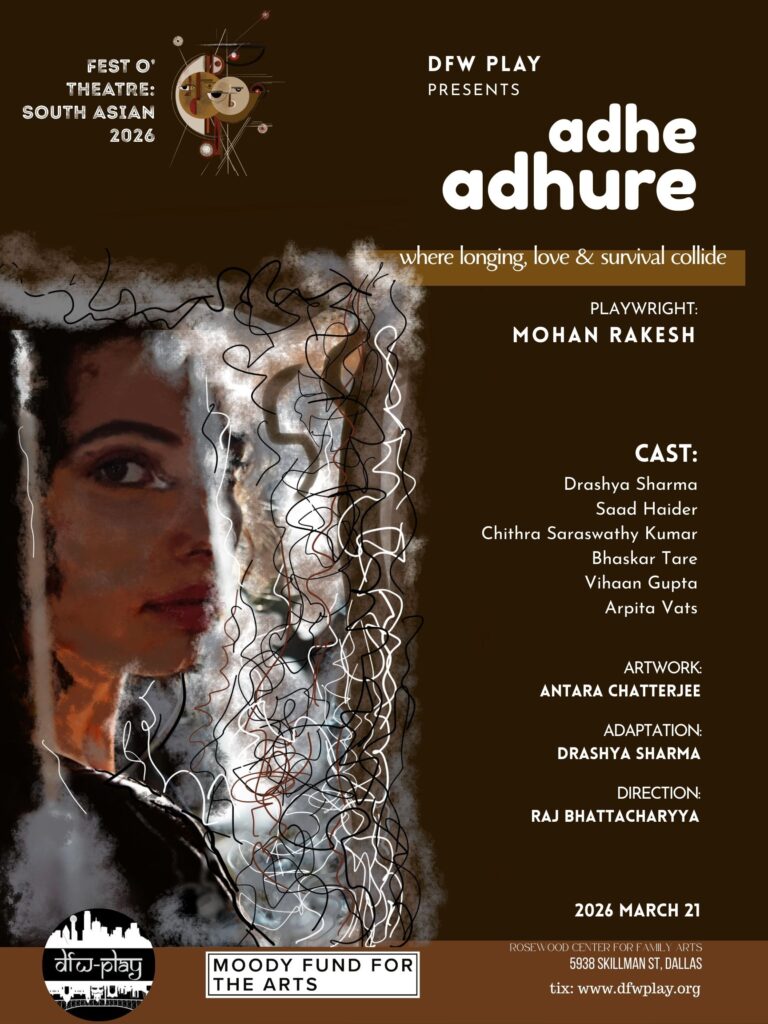
by MOHAN RAKESH
A middle-class home becomes a battleground of unmet desires, fragile egos, and quiet desperation. Adhe Adhure follows Savitri, a woman caught between a passive husband, restless children, and a series of men who seem to promise escape but offer only fragments of stability. As voices clash and silences deepen, the family circles the same conflicts again and again, unable to break free.
With sharp realism and unsparing honesty, Mohan Rakesh’s landmark play exposes the emotional costs of social transition—where roles shift, aspirations collide, and nothing ever feels complete. There is no resolution here, only recognition: of lives lived in repetition, of relationships held together by habit, and of a cycle that begins again even as the curtain falls.
Adhe Adhure is a powerful portrait of incompleteness—intimate, unsettling, and enduringly relevant.
Production: DFW Play, Dallas
Language: Hindi with English supertitles
Adaptation: Drashya Sharma
Direction: Raj Bhattacharyya
Five Grains of Rice
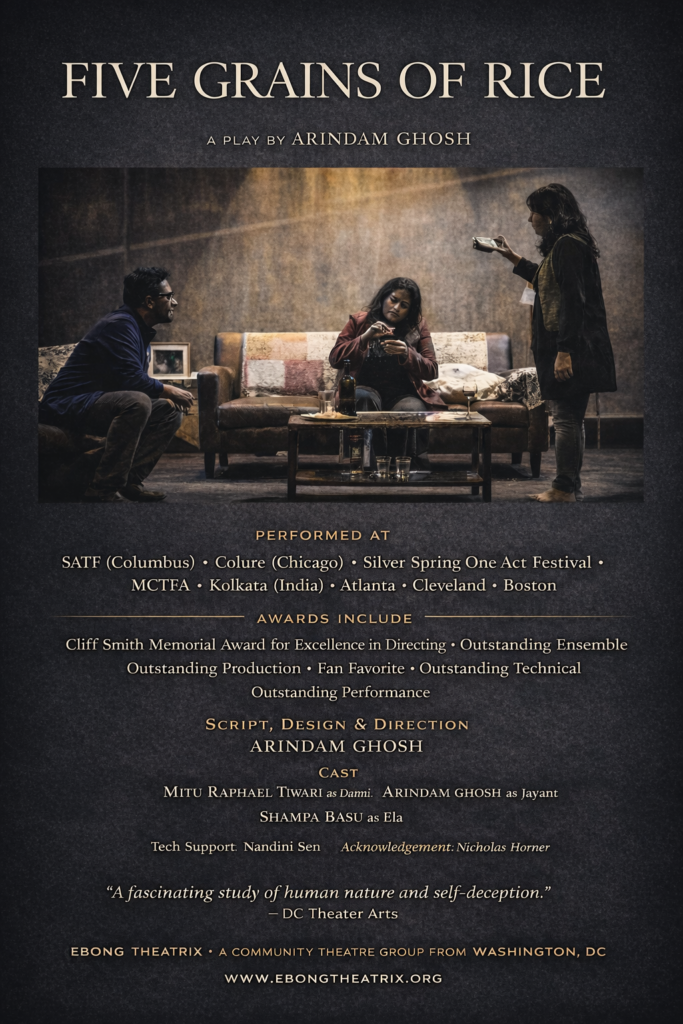
Five Grains of Rice is a taut, intimate drama about love, memory, and emotional survival. Over the course of one evening, a married couple’s carefully constructed world is disrupted by the arrival of a former lover, forcing all three to confront unresolved desires, buried resentments, and the fragile truths that hold relationships together.
Production: Ebong Theatrix, Washington DC
Language: English
Play and Direction: Arindam Ghosh
KOHRA
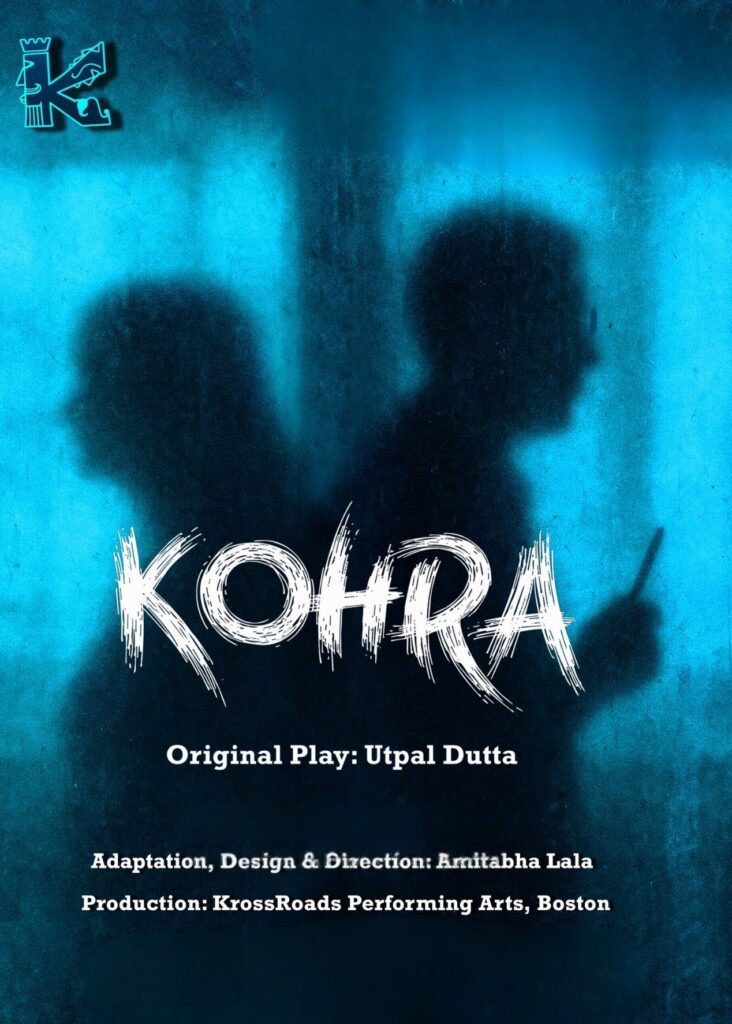
by UTPAL DUTTA
In the mist-draped hills of Shillong, writer Sushant Sanyal lives with his wife Madhuri, seeking refuge from the noise of the world — and perhaps from the echoes of his own past. The quiet of their hill home is deceiving. Beneath the rhythm of rain and Kesarbai Kerkar’s timeless thumri lies a web of secrets, guilt, and unspoken dread.
When Sujata Sen, a woman from Sushant’s past, suddenly disappears, the fog deepens — outside the window and inside the mind. A police officer, Inspector Arup Mitra, arrives with questions that slice through the stillness like lightning. Every word, every pause, turns into evidence.
As the investigation grows murkier, memory and hallucination intertwine. Is Sushant hiding a truth too dark to speak — or is he being devoured by a story he never wrote? Each revelation casts a longer, colder shadow. And ultimately, it is not the murderer but the conscience that stands accused.
“Kohra” is not simply a whodunit; it is a haunting descent into the human psyche, where love, guilt, and madness move like shifting silhouettes in the mist.
Production: KrossRoads Performing Arts, Boston
Language: Hindi with English supertitles
Adaptation & Direction: Amitabha Lala
CAST:
Yagnik Pandya as Sushant Sanyal
Dola Misra as Madhuri Sanyal
Sanjay Jain as Dr. Ray
Naresh Parmar as Bhuvan Mollick
Prerna Mathur as Sujata Sen
Tulan Kanteseria as Sachin Mollick
Amitabha Lala as Inspector Arup Mitra
Guru Anandh as Jatin Jarwa
Jolly Bhatia as Detective Sangma
Music : Dhiman Mondal, Vocal : Mouli Lala and Usha Luthra
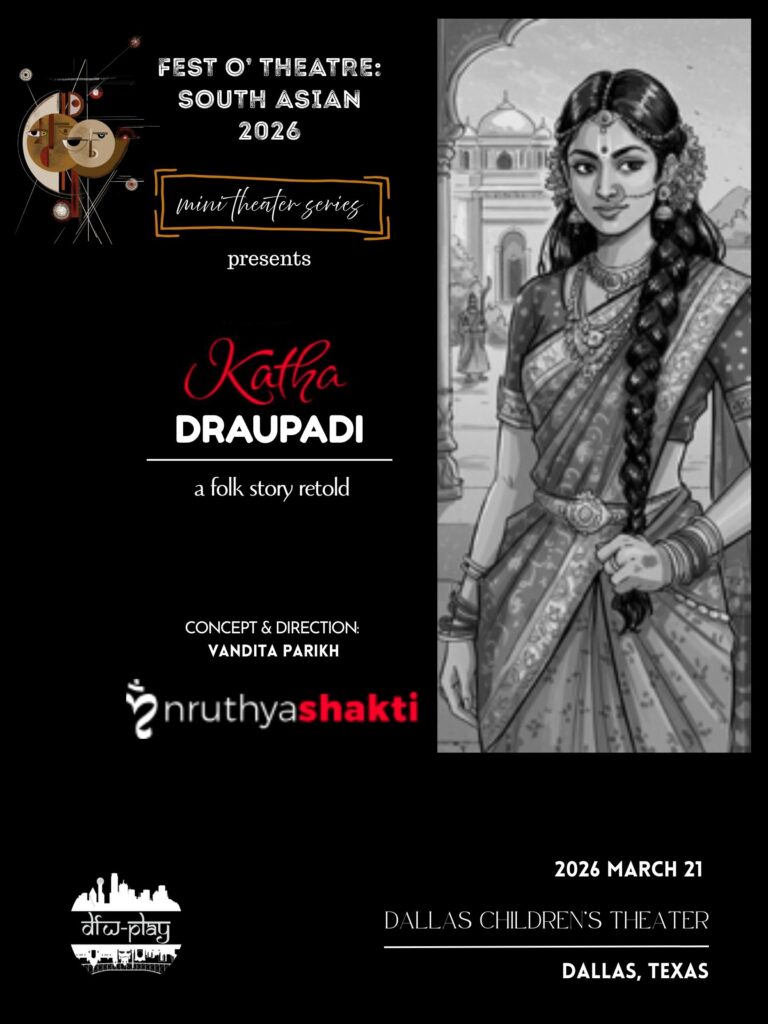
KATHA: DRAUPADI
Woman of Fire, a Folk tale Retold
She was born of fire, not of a womb. Draupadi rose from flame with eyes already awake to the world’s cruelty, her first breath carrying heat, her first cry carrying prophecy. Fire does not ask permission to exist – and neither did she. They called her a princess, but she was a warrior long before she ever saw a battlefield. Not because she held a sword, but because she held her ground.
She had a brother born from the same fire, yet the world never allowed her to stand beside him as an equal. Sons were heirs. Daughters were consequences. She was never treated as a sibling—only as a stake in the game of power.
And then came the lie history loves to repeat. She asked for five husbands. No. Draupadi did not ask. She was given. Five men of valor, five men of legend – yet none had the courage to ask her what she wanted.
And still, history dared to paint her as greedy. As shameless. As excessive. As if a woman must always be blamed when men cannot explain their own failures. She was married to heroes, yet stood alone. When her dignity was dragged into a court, it was not saved by vows or valor—it was saved by her refusal to break. She questioned kings. She challenged the elders. She asked the questions no one wanted spoken aloud: What is dharma if it fails a woman?
They called her vengeful because she remembered.
They called her dangerous because she spoke.
Fire is honest.
Draupadi was not a tragedy – she was a mirror. And the world, seeing itself reflected in her eyes, chose to shatter the glass rather than change its face. She was the daughter of fire. And fire does not forget.
Production: NruthyaShakti Dance Academy (NSDA), Dallas
Concept & Direction: Vandita Parikh

LIFELINE
Who speaks for a woman when she is no longer there to speak for herself?
Life Line is an experimental Telugu play that challenges conventional storytelling by placing absence, perception, and silence at the center of its narrative. Lifeline follows a single day in the life of Anitha, a successful, self-made professional woman navigating the relentless pressures of modern urban existence. Rushing through a chaotic Hyderabad morning, caught between a demanding job, an emotionally distant workplace, and a strained relationship with her daughter, Anitha struggles to balance responsibility, dignity, and emotional survival.
Lifeline is a poignant social drama that questions who speaks for women, who listens, and how easily a life of integrity can be erased by indifference, leaving behind only regret, guilt, and unanswered apologies.
Production: Sarasija Theaters, Dallas
Direction: Rajeswari Udayagiri
Language: Telugu and English
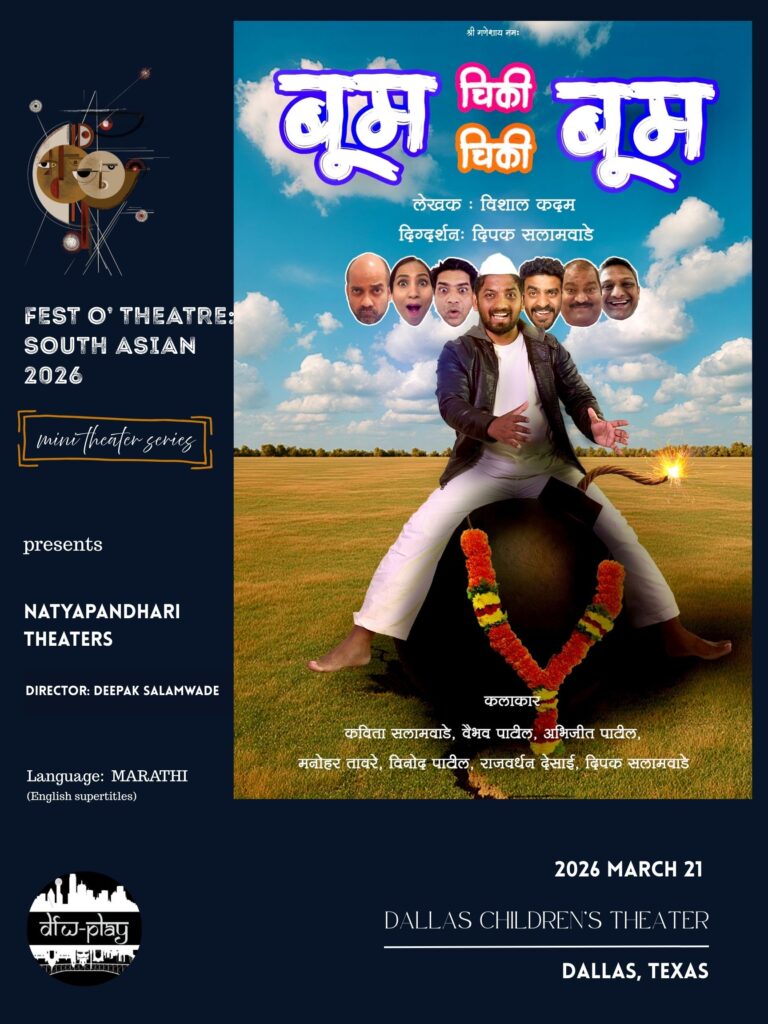
Boom Chiki Chiki Boom
Can Revenge Be a Laughing Matter?
A group of activists driven by revenge set out to strike back at terrorists until Gandhian ideals of truth and non-violence challenge their rage and redefine justice.
Production: Natyapandhari Theaters, Dallas
Direction: Deepak Salamwade
Language: Marathi
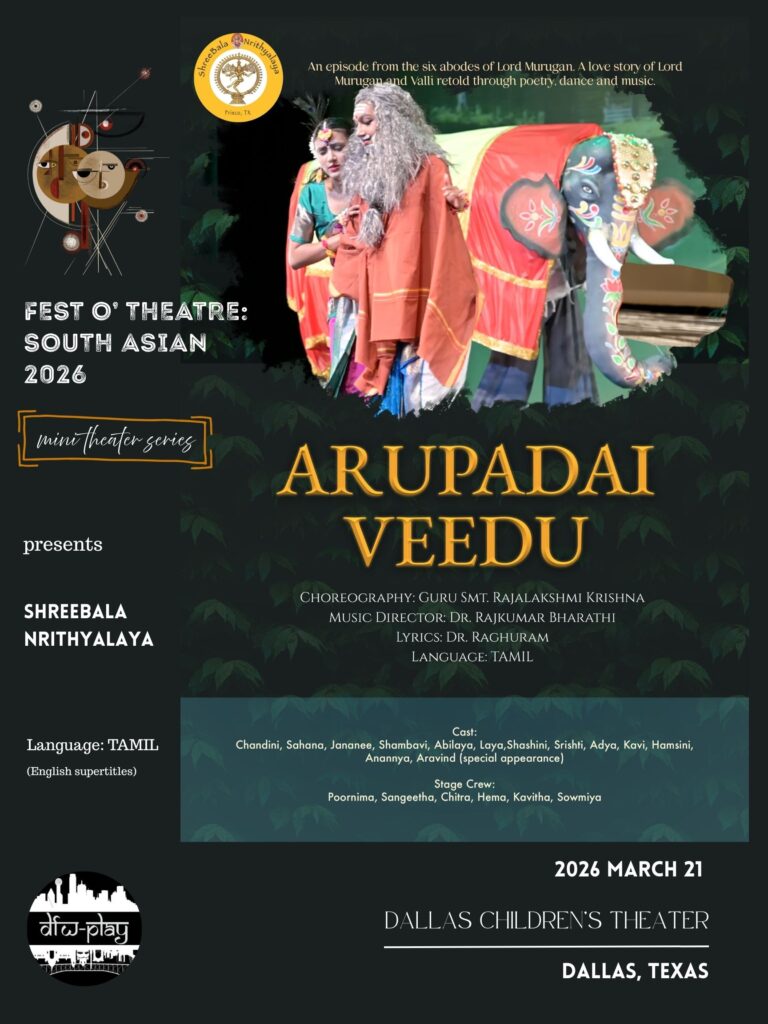
ARUPADAI VEEDU
Ancient lore. Modern soul
‘Arupadai Veedu’ is set to the soul stirring music of Dr. Rajkumar Bharathi and choreographed by Guru Smt. Rajalakshmi Krishna. Witness the enchanting love story of Lord Murugan and tribal princess Valli come to life – a tale filled with devotion, humor, disguise and destiny. Watch as Murugan tests Valli’s love, seeks help from Ganesha and reveals his true divine form in a heart melting moment of reunion. Rooted in Tamil heritage, this presentation blends classical Bharatanatyam with traditional dances like Kavadiattam and Kummi.
Production: ShreeBala Nrithyalaya, Dallas
Concept & Direction: Rajalakshmi Krishna
Language: Tamil
Our Sponsors & Partners